A name that carries more than sound
When I think about Ryden Caspian Paul, I do not think first about fame. I think about shape. I think about how a name can feel like a small house with many rooms, each one holding a different version of a life. Ryden is a child who has lived most of his story offstage, yet even that privacy tells a story of its own. In a culture that often treats family life like open water, his parents have chosen a shoreline approach, letting only a few waves reach the public.
That choice matters. It gives Ryden a different kind of visibility, one that is measured instead of constant. There are families who build their lives in front of the camera, and there are families who leave a lantern in the window and keep the rest of the house dim. The Paul family seems to lean toward the second style. I find that striking, because it is rare in celebrity life, where the current usually pulls everything into view.
Ryden Caspian Paul is still very young, but his name already suggests a layered identity. It sounds polished, almost ceremonial, yet it belongs to an ordinary childhood filled with the usual small miracles. First words. Bedtime routines. Sibling noise. Tiny negotiations over food, sleep, and attention. Childhood is a short season, but it can feel immense from the inside. For Ryden, that season is unfolding under a careful kind of sunlight.
The family orbit around Ryden Caspian Paul
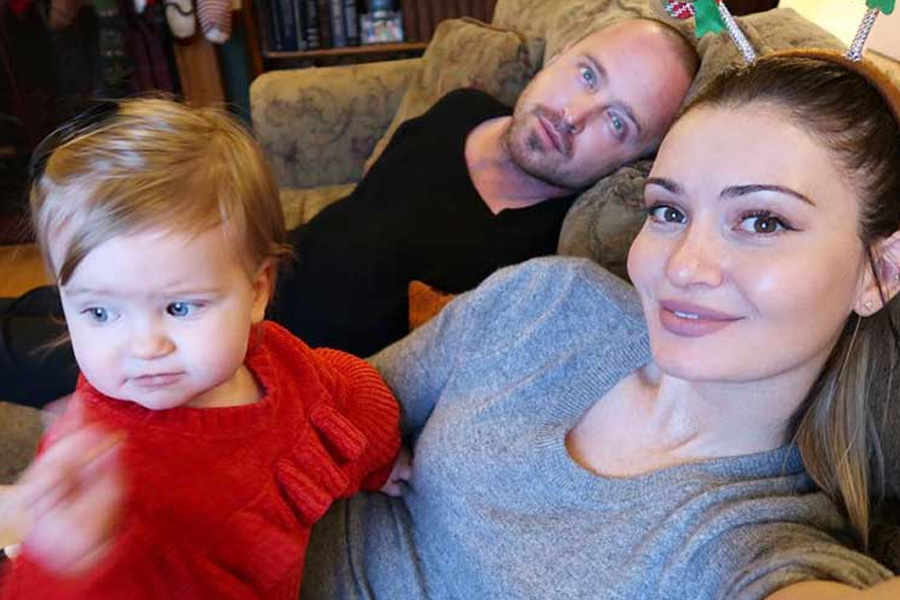
Every child grows inside a constellation, and Ryden Caspian Paul’s constellation is especially bright. His father, Aaron Paul, is widely recognized, but at home that public identity becomes something simpler and more human. It becomes dad. It becomes the person who remembers snacks, the person who notices the small mood shift in a room, the person who is trying to be present while the world still wants a piece of him.
His mother, Lauren Parsekian Paul, brings a different but equally important energy to the family story. She is associated with advocacy, creativity, and a steady commitment to kindness. That kind of influence does not always announce itself loudly. Sometimes it appears in the texture of family life. It shows up in how people speak to one another, how they resolve stress, how they make room for one another’s edges.
Ryden’s older sister, Story Annabelle, adds another dimension to the household. Sibling relationships can act like weather systems. They shift quickly, and they teach quickly. A big sister can become a guide, a rival, a protector, and a comedian all in one afternoon. In a family like this, the bond between siblings is not just a detail. It is the engine of daily life.
Then there is Bryan Cranston, Ryden’s godfather, a relationship that gives the family story a sense of continuity. Godparents are often treated like ceremonial figures, but in real life they can become a bridge between generations, a witness to change, a steady hand. In this case, the tie also reflects a long friendship rooted in professional history and personal loyalty. That kind of bond can make a family feel anchored, like a ship with a trustworthy mooring line.
Privacy as a form of care
I keep returning to privacy because it seems to be the clearest theme in Ryden’s early life. Not secrecy, exactly. More like shelter. The difference matters. Secrecy shuts a door. Shelter creates a room.
The public glimpses around Ryden have been brief and selective. A shared anecdote here. A passing mention there. A family post that offers warmth without exposure. In a digital age that rewards oversharing, restraint can feel almost radical. It also feels protective in the deepest sense, because children do not choose celebrity life. They inherit its weather.
That is why the limited public presence around Ryden seems less like absence and more like intention. His parents appear to be drawing a boundary around childhood, keeping the center of gravity close to home. I see that as a form of parenthood that understands the difference between memory and performance. Some moments are meant to be lived, not archived.
The language around Ryden also reflects this care. Even the shift from one name to another suggests a family making space for a child to become himself. Names are not just labels. They are little weather systems of meaning. A name can be a flag, a wish, a map, or a doorway. In Ryden’s case, the final chosen name seems to carry both softness and structure, as if it was selected not just for how it sounds, but for how it might hold a life.
From Los Angeles to Paris, and what that move means
One of the most interesting newer developments in the wider family story is geographic. The family’s reported move from Los Angeles to Paris adds a new layer to how I think about Ryden Caspian Paul. A move like that is never only about houses. It is about atmosphere, rhythm, and the kind of childhood a parent hopes to build.
Los Angeles can feel like a city of mirrors, where fame reflects itself endlessly. Paris, by contrast, carries a different pulse. It is older, denser, and more textured. Streets feel lived in rather than staged. Light behaves differently there. A family relocating from one to the other is not just changing addresses. It is changing the emotional acoustics of daily life.
That matters for children. Children absorb environments the way fabric absorbs dye. They notice sidewalks, routines, accents, routines again, the pace of a bakery line, the sound of a school morning, the mood of a neighborhood park. If Ryden is growing up partly in Paris now, then his childhood is being shaped by a cross current of cultures. That kind of upbringing can make the world feel both larger and more intimate at once.
I also think the move says something about priorities. Leaving a familiar city is rarely simple, especially when it comes with a long public history. Yet sometimes families make large shifts because their private life has changed its center of gravity. The result is not drama. It is recalibration.
Fame, money, and the strange arithmetic of public life
Celebrity culture loves numbers, but children do not live as numbers. Still, the money side of public life inevitably enters the picture. Aaron Paul’s career has made the family financially comfortable, and estimates of his net worth continue to circulate widely. Real estate decisions, public listings, and major moves all become part of the story whether anyone asks for that attention or not.
What interests me is not the total itself, but what it makes possible. Financial security can buy time, space, and privacy. It can help parents make choices that are less reactive and more deliberate. In a family with public recognition, that cushion is not trivial. It can be the difference between living inside the machine and stepping just far enough outside it to breathe.
At the same time, money never solves the whole puzzle. It cannot manufacture normal childhood. It cannot guarantee calm. It cannot shield a child from curiosity forever. What it can do is widen the set of available choices. For Ryden Caspian Paul, that may be the most meaningful part. Not luxury for its own sake, but the freedom to grow with fewer interruptions.
Why the name Ryden Caspian Paul stands out
I keep coming back to the name itself because it feels like the key to the whole portrait. Ryden Caspian Paul sounds fluid and grounded at the same time. It has movement in it, like water crossing stone. It also has a finality, a sense of belonging. The rhythm is memorable without being theatrical.
That balance mirrors the family around him. There is public recognition, but not surrender. There is affection, but not exposure. There is a creative household, but one that seems to understand the value of ordinary hours. I suspect that is part of what makes this story compelling. It is not built on spectacle. It is built on subtraction.
In many celebrity families, children become extensions of brand language. Here, the approach feels different. Ryden is not being used as a public symbol. He is being protected as a person. That distinction is easy to miss, but it changes everything.
FAQ
Who is Ryden Caspian Paul?
Ryden Caspian Paul is the younger child of Aaron Paul and Lauren Parsekian Paul. He is known publicly only through occasional family references and carefully shared glimpses.
Why does his name matter so much in public discussion?
His name drew attention because it changed after his birth, and because it reflects a family that seems deliberate about identity, privacy, and how much of childhood belongs to the public eye.
Does Ryden have siblings?
Yes. He has an older sister, Story Annabelle, who plays a visible role in the family’s broader story.
Why do people discuss the family’s move to Paris?
The move is notable because it signals a major shift in lifestyle, privacy, and daily rhythm. It also suggests the family wanted a different environment from Los Angeles.
Is Ryden often seen in public?
No. His presence in public life remains limited, and that limited visibility appears to be intentional.
Why is Bryan Cranston part of the story?
Bryan Cranston is Ryden’s godfather, which adds another layer to the family’s close personal circle and reflects a long-standing friendship around Aaron Paul’s life.
What makes Ryden’s story different from many celebrity children’s stories?
What stands out is restraint. His life has been described through small details rather than constant exposure, which gives the story a quieter, more thoughtful shape.
Building A Warmer Minneapolis Home From The Inside Out
What To Know Before You Bring Home A Beach House
The House That Keeps Its Cool And Locks Its Doors
Building A Warmer Minneapolis Home From The Inside Out
Park City Comes Alive Through Art Music And Mountain Culture